
Podcasts
Practical, compassionate guidance from GBMC clinicians for every stage of life.
When Michele Johnson noticed her left leg swelling—tripling in size from thigh to ankle—she assumed something temporary was wrong. She rarely got sick, aside from the occasional cold, and had no reason to suspect anything serious. But as the swelling worsened and her abdomen began to feel painfully overfilled, Michele knew something wasn’t right. “I was just really tired,” she recalls. “Aside from the leg swelling, that was my biggest symptom.”
Initial lab work ordered by her primary care provider showed her kidney numbers were concerning—and getting worse. Referrals followed, including one to a kidney specialist, but the earliest available appointment was months away. Michele was in too much discomfort to wait.
She began seeing additional specialists, eventually connecting with a urologist who “understood how overwhelming it is for patients to be sent all over the place.” Michele says, “She really helped consolidate my care so I could get everything I needed in one place.”
The urologist discovered that Michele’s kidneys were swollen and that her bladder was not emptying properly. Further testing revealed a blockage—but its cause wasn’t immediately clear. The situation was urgent, so Michele was quickly referred to Kimberly Levinson, MD, a gynecologic oncologist with the Sandra & Malcolm Berman Cancer Institute at GBMC.
Dr. Levinson saw Michele the very next day.
“I was terrified when I heard the word ‘oncologist,’” Michele says. “When Dr. Levinson told me I had stage 3 cervical cancer, I didn’t hear anything after the ‘c’ word. I thought it was a death sentence.”
But Dr. Levinson approached the diagnosis with both clarity and compassion, encouraging Michele to focus on one step at a time. Before cancer treatment could begin, Michele’s kidney function had to be stabilized to prevent kidney failure.
That meant a nephrostomy procedure—placing tubes directly into her kidneys to allow urine to drain—along with a Foley catheter. At one point, Michele was managing three external drainage bags. “It was miserable,” she says. “I couldn’t sit or stand for long, and I had to constantly adjust my clothes around the tubes. But it was what I needed to stay alive.”
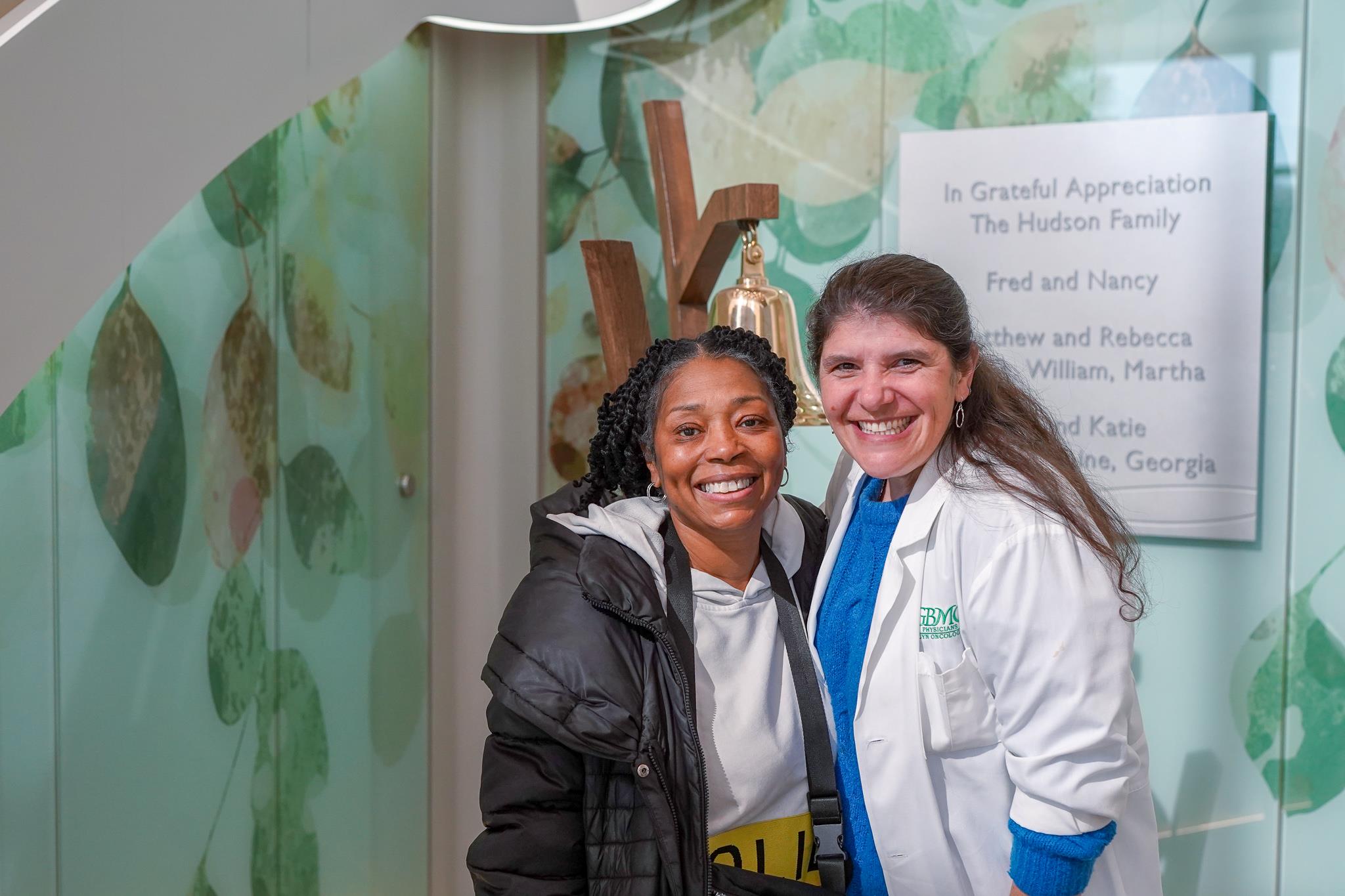
Once her kidneys were stable, Michele began an intensive course of treatment: five weeks of daily radiation therapy paired with weekly chemotherapy. Her radiation oncologist, Geoffrey Neuner, MD, along with Dr. Levinson, gynecologic oncology nurse Erin Gingher, RN, and the entire oncology care team, quickly became more than providers—they became family.
“They were amazing,” Michele says. “Even on the hardest days, I looked forward to seeing them.”
While chemotherapy caused significant nausea and weight loss, Michele was grateful for how closely her symptoms were managed. Radiation caused minimal side effects, and her team remained attentive, encouraging, and reassuring throughout every phase of treatment.
Her final radiation therapy—brachytherapy—involved placing targeted radiation directly near the tumor. Though physically demanding, Michele says her care team ensured she remained comfortable and supported.
Today, Michele’s primary treatment is complete. She continues with shorter, less intensive chemotherapy sessions every six weeks to reduce the risk of recurrence. Recently, after months of discomfort, she finally had her Foley catheter removed. “That was the worst part of everything,” she says. “Having it gone was such a relief.”
Now back at work and full of energy, Michele says cancer has changed how she sees life. “I’m just happy to be here,” she says. “I have so much appreciation for every day.”
She hopes her story encourages others not to ignore unusual symptoms—even if they seem small. “If something feels off, go to the doctor,” Michele says. “The timing can be life or death. If I hadn’t connected with the right doctors when I did, I wouldn’t be here.”
For Michele, having coordinated care under one roof made all the difference. “Come to GBMC,” she says. “Everything works together here.” Her advice is simple—and heartfelt: “Keep praying. Keep positive energy. Don’t give up. And do everything your doctors tell you to do.”
As she puts it with gratitude, “Dr. Levinson, Dr. Neuner, the chemo team—we’re family.”
From Paari Gopalakrishnan, MD, MBA, GBMC HealthCare, President and CEOAs a hospitalist, I heard this ques...
Marsha Hammond's positivity is catching. In fact, she does what she can to share it with anyone who might...
For Matt Bollinger, compassionate healthcare has always been personal. As president of Bollinger Energy a...
On September 15, 2026, at the Vision GBMC event, Dr. Paari Gopalakrishnan, President and CEO, reflected o...
Practical, compassionate guidance from GBMC clinicians for every stage of life.