Podcasts
Practical, compassionate guidance from GBMC clinicians for every stage of life.

Few things can change the tone of your day faster than parking, especially when you’re trying to get to work on time or help a patient arrive with a little less stress.
I’ve learned that people tend to have very strong parking personalities. Are you a parking lot hunter or a prudent parker?
My wife and I are opposites in this area. She is a parking lot hunter... an optimistic parker who is willing to circle a little longer to find that perfect close spot. I, on the other hand, am a prudent parker. I usually head toward the back, take the first reasonable spot I see, and keep moving. Now, I am not completely boring. I do appreciate the rare “drive-through spot” where there are two open spaces lined up end-to-end so you can pull straight through and make a clean forward exit. That, in my opinion, is winning the parking lottery!
Parking philosophies may be personal, but in healthcare, parking cannot just be about personal preference. At a healthcare organization, it affects patients, visitors, and staff in very real ways.
That said, I hear you. I know parking can be frustrating, and I know we need to make improvements.
Part of the challenge is that this is not simply a matter of not having enough spaces. With the opening of the Berman Garage, GBMC now has 3,416 on-site parking spaces, which is the highest parking capacity in our history. The bigger issue is that some garages are overused, some are underused, and some need repair or rethinking so we can make the whole system work better. Recent utilization data show, for example, that Lily Garage is much more heavily used than some of our other parking areas.
As many of you know, the Daffodil Garage has been closed since June 2023, and most of the structure has now been demolished. After reviewing several replacement options ranging from about $13 million to $60 million, we made the decision not to rebuild another garage there right now. Instead, the current plan is to redevelop that site as an open-air parking lot, primarily to support patients of Physicians Pavilion West.
That decision reflects a broader reality. Parking matters, but so do aging hospital infrastructure, critical equipment, patient care spaces, and continued investment in access across our health system. We have to be thoughtful about where funding goes.
We are in the process of putting together a multi-disciplinary parking task force. Over the next 6 to 9 months, this task force will evaluate utilization, repairs, traffic flow, and how we better align parking resources across campus. The goal is to have a clearer plan by late summer or early fall. That may include shifting more staff parking areas.
And I want to be transparent about one important principle: patients will always come first when it comes to parking priority. That has to be true in a healthcare setting. After that, we need to make the staff parking experience as fair, workable, and safe as possible.
This will not be solved overnight. I know that. But I am not ignoring it. I hear the frustration, and I am committed to improving it.
And if you are wondering where I park, you can probably guess: I am still a prudent parker.

How long have you been at GBMC HealthCare?
5.5 years
What is one key way you support a zero harm/safety culture?
I focus on creating an environment where concerns can be raised openly. Modeling thoughtful decision making, clear communication, and accountability, I help build trust within my team and with our partners.
What is the most rewarding part of your job?
I find this work rewarding because it gives me the opportunity to contribute to both outcomes and the growth of others. I am part of a team that navigates complex relationships and represents care that truly matters, and I am grateful to support their efforts. I take pride in helping foster stronger partnerships and improving access in ways that benefit the communities we serve. When my team operates effectively, trust with referral sources deepens, transitions become smoother, and more patients are connected to the right care at the right time. It is meaningful to step back and see those efforts come together in how the community experiences our support.
What is your favorite animal?
Elephants are my favorite animal. I had the privilege of staying at an elephant sanctuary in Thailand.
COMMENTS
**Robert Cole commented on 4/30/26 at 08:51:**
Thank you for your article. As the person who has been doing Parking Enforcement since the Construction on the Freidman Building began, I know firsthand the frustrations our Patients, Visitors, & Employees feel. I am currently on light duty but am hoping to be back to doing Parking Enforcement by the end of June.
Robert "Buddy" Cole
**Dr. Gopalakrishnan replied:**
You're welcome Buddy. I am optimistic that our taskforce will get to solid spot.
**Anonymous commented on 4/29/26 at 18:40:**
Hi Dr. G,
Would it be possible to change the floral names of the parking lots?
Also, could we have improved signage like Sheppard Pratt, or clean the existing signage around the campus. It looks shabby in places, and GBMC isn't shabby.
Thank you for your consideration.
Nancy Shackelford, RN ( retired) Volunteer in North Pavilion.
**Dr. Gopalakrishnan replied:**
Thank you Nancy. I will forward to our taskforce to consider.
**Christina Fitts commented on 4/28/26 at 11:16:**
I am a 'dropper offer', so I am thinking of my residents' limited mobility when I come on campus. Since I serve as a valet of sorts, I take what's available not thinking about convenience, but as my one knee becomes problematic, I will probably take on your wife's outlook
**Dr. Gopalakrishnan replied:**
Philosophies can evolve:)
**Felicity Kirby commented on 4/28/26 at 08:04:**
I'd like to share an observation regarding traffic flow near the lower parking lot serving the Coumadin clinic and neurology, as well as the exit from Berman Garage. This area currently brings together multiple traffic streams-vehicles coming from Farmhouse, the road to the ER and North, and those exiting the parking lot-all converging at a single point. In addition, there is regular pedestrian crossing in this same area, which adds to the complexity and potential safety concerns.
As a possible improvement, it may be worth considering a traffic circle at this convergence point to help regulate flow and reduce conflict between vehicles and pedestrians. A similar approach could also be explored at the main hospital driveway entrance, where drivers currently choose between turning right toward the main entrance or left toward the ER.
Both options might improve traffic organization, enhance safety, and create a more intuitive driving experience for patients and visitors.
**Dr. Gopalakrishnan replied:**
Thank you Feliciity for the suggestion. I am forwarding your comment to our taskforce.
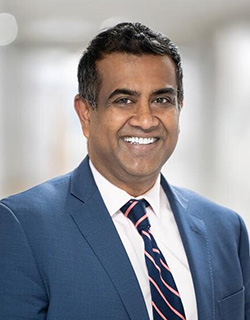
Bringing more than two decades of clinical and executive leadership experience, Dr. G is known for his commitment to transparency, accountability, and compassion. Learn more...
One of my favorite parts of our Monthly Leadership Meeting is something we call the Power of One.Each mon...
At our monthly leadership meeting recently, Brandon Costantino, Administrative Director from the Milton J...
Over the past year, one of the most important things I’ve focused on has been making sure we have the right leaders in the right roles.
I know many of you were probably sitting by your inbox at 6:30 Tuesday morning, eagerly waiting for this ...
One of the things I continue to appreciate about GBMC is just how many special communities exist within o...
I have a confession to make: I recently got scammed by our own IT team.An email landed in my inbox from â...
Practical, compassionate guidance from GBMC clinicians for every stage of life.