Podcasts
Practical, compassionate guidance from GBMC clinicians for every stage of life.

As a hospitalist, I heard this question often (and understandably):
“When can I go home?”
Sometimes, patients asked it shortly after they arrived. I always admired the optimism.
More often, the question came after several days of tests, consultations, medications, therapy, and conversations with family. Patients were not necessarily asking to leave before they were ready. They were asking something more basic:
What still needs to happen, and is everyone on the same page?
No patient should feel rushed out of the hospital. Going home before it is medically safe can lead to complications or a return visit. But staying in the hospital longer than necessary is not harmless either. Hospitalization interrupts sleep, routines, independence, and time with loved ones. It can also expose patients to additional risks.
As I've written about before, our responsibility is to find the right moment: not too soon, not too late, and with the patient and family prepared for what comes next.
GBMC is making changes to help that moment arrive with fewer unnecessary delays.
A safe discharge can depend on many people. A physician may be waiting for a test result. A nurse may identify a new concern. A care manager may be arranging home services or a rehabilitation placement. A therapist may need to confirm that the patient can safely move around at home. Pharmacy, imaging, laboratory services, wound care, and other teams may each hold an important piece of the plan.
Traditionally, those pieces have not always come together at the same time.
During unit-based rounds, the care team might identify that a patient was waiting for an MRI, a blood draw, a consultation, or a medication plan. Then, after rounds, someone would begin calling, paging, and messaging the appropriate department.
Sometimes several people were trying to solve the same problem. Other times, the delay came down to one missing form, one unanswered question, or one issue that needed to be escalated.
The people were working hard. The process made it harder than it needed to be.
That is what our Market Place Rounds initiative is designed to change.
GBMC launched Market Place Rounds on July 13, 2026, as a new, centralized approach to bringing the right people together at the same time. Each morning, physicians, nurses, care managers, and others from participating inpatient units meet in one location. Representatives from imaging, laboratory services, pharmacy, physical therapy, wound care, and other support departments are nearby. Clinical and operational leaders are also present when a barrier needs to be escalated.
When a team identifies a problem, they do not simply add it to a list and hope someone can resolve it later.
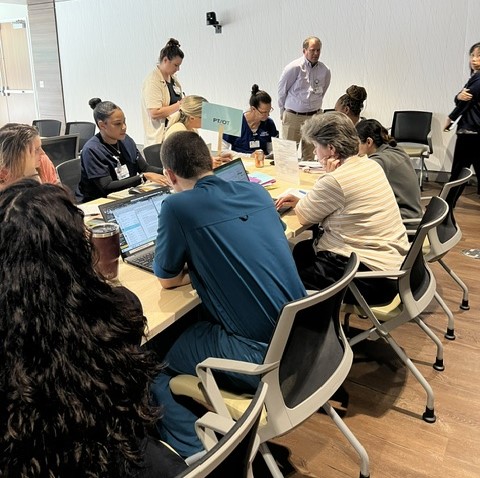 |
| Unit participants flag a PT/OT team member to troubleshoot in real time during Market Place Rounds. |
They connect with the right person then and there.
A delayed MRI may be waiting on a checklist. A blood draw needed before discharge can be prioritized. A consultation that has not occurred can be raised immediately. Instead of spending the afternoon tracking down an answer, the team can begin solving the problem while everyone is together.
Tim Saunders, MSW, LCSW-C, and JoAnn Parr, MSN, MS-HCM, RN-C, Director of Care Management and Continuing Care Services, are helping lead the initiative. They put things into perspective, explaining that it's more beneficial to spend 30 focused minutes together in the morning than two hours trying to resolve the same issue later in the day.
The people participating in the rounds are already seeing the difference.
Carlene Mello, MSN, CNML, RN-BC, NE-BC, Nurse Manager for Unit 52 and Stroke Clinical Program Supervisor, calls the process “quick and efficient.” Recently, her team was able to connect with an ancillary department about testing a patient needed before going home. The testing was expedited, helping the patient move closer to discharge.
Leticia Armstrong, MBA, R.T.(R)(CT)(M), CPPS, Senior Director of Imaging and Cardiac Services, says the 30-minute, in-person rounds have strengthened communication between ancillary departments and medical teams. “In most cases, we can resolve the issue before we leave the room,” she says. The rounds are also uncovering broader opportunities for improvement. For example, one longstanding anticoagulant policy issue between Radiology and Pharmacy was corrected in less than 24 hours, and the team has identified an opportunity to strengthen the process on weekends.
Social worker Marsha Fauver, MSW, LCSW-C, says the new format helps everyone get to the “meat and potatoes” of each case. Conversations are more focused, barriers are addressed in real time, and rounds take less time, leaving more of the day for patients, families, and treatment planning.
Prakash Acharya, MD, a GBMC hospitalist, sees another benefit: “Done right, it can surface hidden inefficiencies and give us the insight to design better workflows. From what I’ve seen so far, we’re doing it right.”
That is important because the goal is not simply to fix one delay for one patient. It is to recognize when the same obstacle keeps appearing and improve the process for the next patient, too.
And Melvin Blanchard, MD, Chairman of Medicine and one of the physician leaders of the effort, brings the conversation back to what matters most. Patients, he noted, want to return safely to home, school, work, and the activities that give their lives meaning.
That is the real purpose of this work.
Hospitals may use terms like “length of stay” and “patient throughput.” Patients do not experience a metric or a flowchart.
They experience waiting.
They experience wondering whether the test has been scheduled, whether the equipment has been ordered, or whether everyone is working from the same plan.
Market Place Rounds is helping turn those separate questions into one coordinated conversation.
As a hospitalist, I often found that the answer a patient needed existed somewhere in the hospital. The challenge was getting the right people connected at the right time.
Now, instead of asking, “Who do we need to call?” we are more often able to say, “They’re right here.”
And that can make all the difference between almost ready and safely home.

Bringing more than two decades of clinical and executive leadership experience, Dr. G is known for his commitment to transparency, accountability, and compassion. Learn more...
One of my favorite parts of our Monthly Leadership Meeting is something we call the Power of One.Each mon...
At our monthly leadership meeting recently, Brandon Costantino, Administrative Director from the Milton J...
Over the past year, one of the most important things I’ve focused on has been making sure we have the right leaders in the right roles.
I know many of you were probably sitting by your inbox at 6:30 Tuesday morning, eagerly waiting for this ...
One of the things I continue to appreciate about GBMC is just how many special communities exist within o...
I have a confession to make: I recently got scammed by our own IT team.An email landed in my inbox from â...
Practical, compassionate guidance from GBMC clinicians for every stage of life.