Podcasts
Practical, compassionate guidance from GBMC clinicians for every stage of life.
Told He Was Beyond Surgery, Jack French Found a Team That Refused to Accept That Verdict. Nine Years Later, He’s All About Having Fun.
Jack French didn’t call to talk about cancer.
He called to talk about a parade.
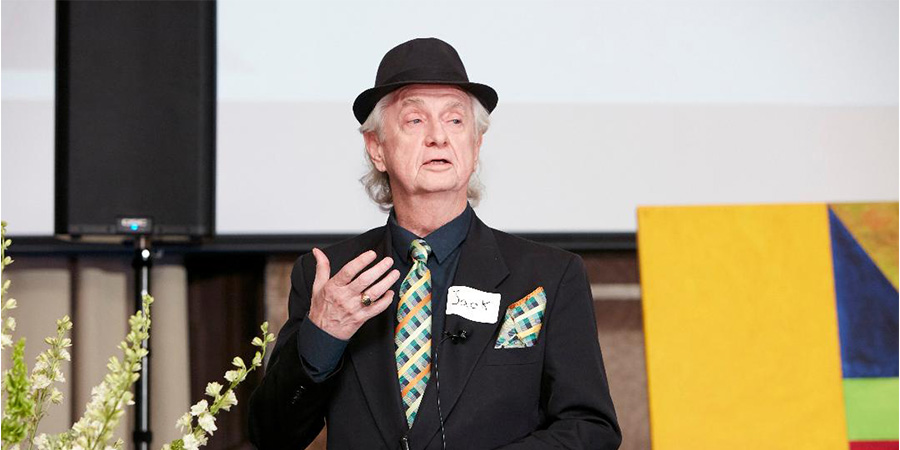
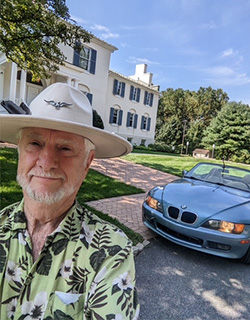
This St. Patrick’s Day, the 78-year-old is putting his BMW Z-3 in the holiday parade in Baltimore and doing it again in Annapolis. He even reached back for the soundtrack—the old standard “I Love a Parade”—like a man narrating his own opening scene.
“It’s something I’ve always wanted to do,” he said, with the straightforward certainty of someone who’s done waiting.
And then the line that carried the full weight of what this conversation was actually about: “I’m a nine-year cancer survivor, thanks to GBMC.”
Jack has the joyful specificity of someone who knows exactly what he likes: Star Wars, the original Mission: Impossible, James Bond. Big-screen heroes who beat impossible odds. He’s embracing all the things he can do, not in a bumper-sticker way, but in the very practical way you do when your life has been interrupted once, and you’ve decided you’re never giving it that permission again.
 The Moment Everything Narrowed
When Jack was diagnosed with Stage Four HPV-related head and neck cancer, the news was difficult enough. What came next was worse. Another institution evaluated his case and delivered a verdict that carried the weight of finality: he was “beyond surgery.” He had his case reviewed by a number of leading cancer centers. The answers were the same.
Those two words can shrink a person’s world to the size of a waiting room. Jack remembers how that felt, not just the fear, but the flattening. The sense that his story was being rewritten by people who didn’t know him.
And then Jack found a team that widened the hallway again.
A Center Built on Understanding
Jack received care through GBMC’s Milton J. Dance, Jr. Head and Neck Center. To understand why that matters, it helps to know how the Center came to exist.
In 1979, Jeanne Gilchrist Vance and her husband Milton “Laddie” Dance watched Laddie undergo treatment for head and neck cancer. What they experienced—both the medicine and the gaps around it—moved them to build something different. They established the Dance Center on a foundational belief: treating these cancers demands more than surgical skill. It demands a profound understanding of what they take from a person.
Head and neck surgeon Farzad Masroor, MD, captures the Center’s guiding philosophy simply: the head and the neck are “the center of your existence.” It’s how we speak, eat, laugh, show up in the world. When cancer strikes there, the stakes are personal in the deepest way.
The Dance Center reflects that reality. Surgery is paired with rehabilitation, speech-language pathology, counseling, and support, because surviving is not the finish line. Living is.
For Jack, that philosophy was embodied in Dr. Karen Pitman, his head and neck surgeon at GBMC. Dr. Pitman, who retired after a distinguished career, didn’t see a patient who was “beyond” anything. She saw Jack French, a man whose cancer was complex, but whose case deserved the weight of an entire team finding a way forward.
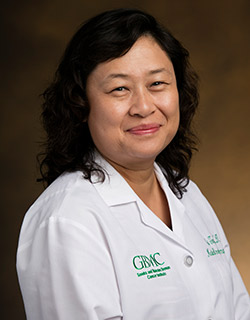
His chemo oncologist, Dr. Mei Tang, led his chemotherapy care as part of a multi-disciplinary team that surrounded Jack at every step. Treatment was grueling. He lost 22 pounds and could not taste or smell for four months. But Jack came into that fight with intentions of his own.
He requested no gastric feeding tube. He requested no stress or anxiety medication. And the GBMC team listened the way they were built to listen and respected his request. In place of medication, Jack turned to a canvas. He channeled his anxiety and fear into painting, creating a work that now hangs in the Oncology Department’s patient waiting room, part of a larger body of work currently on exhibition in Baltimore.
The Doctor Who Chose Connection
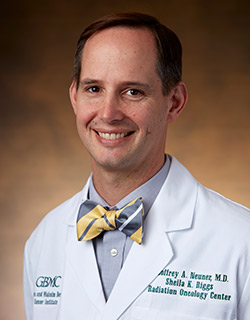
While Jack’s path involved multiple disciplines, the gratitude in his voice centers on one person: Geoffrey Neuner, MD, Chair of the Department of Radiation Oncology.
Dr. Neuner’s story has a detail that says everything about the kind of physician he is. Early in his training, he was on track to become a psychiatrist. Then, a research project introduced him to radiation oncology and he discovered something unexpected. It wasn’t the technology that pulled him in. It was the relationships. The chance to form meaningful connections with patients at the most critical moments of their lives.
At the Sheila K. Riggs Radiation Oncology Center, Dr. Neuner pairs that commitment with advanced precision radiation technology. But for Jack, what mattered most was someone believed his fight wasn’t over and treated him like it wasn’t.
That relationship endured well beyond treatment. Jack was invited as the Keynote Speaker at GBMC's annual Cancer Survivorship Celebration, and his contributions to cancer care research didn’t stop there. Jack participated in a 2017 taste test study whose findings traveled far: the report reached Brazil, where he was recognized for his involvement.
The Bell and the Wide-Open Road
At GBMC’s Sandra & Malcolm Berman Cancer Institute, a Survivorship Bell waits for patients who make it through treatment. Ringing it is not just a ceremony. It’s a line drawn between the fight and whatever comes next.
When Jack rang that bell, he rang it for everyone who’d carried him through: Dr. Neuner, Dr. Pitman, every nurse and therapist on the journey. He rang it for every patient still in a waiting room who needed to hear it. And he rang it for himself, for the man who’d been told his story was ending and refused to believe it.
Then Jack did what Jack does. He booked a cruise with his girlfriend. And he bought a motorcycle.
At 78, after a successful career and nine years on the other side of a diagnosis that once seemed insurmountable, Jack has arrived at a philosophy that is equal parts earned wisdom and pure joy: “I’m all about having fun.”
That sentence sounds casual, until you realize how hard-won it is. Fun, for Jack, isn’t frivolous. It’s defiant. Not “patient,” not “case,” not “beyond” anything, just a man doing all the things he’s always wanted to do, with the clarity to finally do them.
Star Wars. Bond films. A motorcycle on the open road. A convertible in a parade. And, as a reward to himself after everything he’d been through, Jack purchased an airplane and taught himself to fly it. These aren’t small pleasures. These are the dividends of a second chance.
Jack’s story is not simply about surviving cancer. It’s about what happens when a healthcare team refuses to accept someone else’s verdict.
At GBMC, the Sandra & Malcolm Berman Cancer Institute, now in the newly opened Sandra R. Berman Pavilion, brings the full spectrum of cancer care under one roof. But what patients like Jack will tell you is GBMC’s difference isn’t about buildings or technology. It’s about a culture where a surgeon says, “I felt I could accompany patients as they go through this journey,” and a radiation oncologist chose his field to form deep relationships at the most critical moments in people’s lives.
It’s about looking at a man who was told he was beyond surgery and seeing all the parades still ahead of him.
Somewhere on a parade route this March, in a sea of green, there will be a BMW Z-3 driven by a 78-year-old who once heard the words “beyond surgery.”
He’ll have the top down. He’ll be smiling.
Not a survival story. A living story.
From Paari Gopalakrishnan, MD, MBA, GBMC HealthCare, President and CEOAs a hospitalist, I heard this ques...
Marsha Hammond's positivity is catching. In fact, she does what she can to share it with anyone who might...
For Matt Bollinger, compassionate healthcare has always been personal. As president of Bollinger Energy a...
On September 15, 2026, at the Vision GBMC event, Dr. Paari Gopalakrishnan, President and CEO, reflected o...

Services Offered3D Conformal Radiation Therapy: With 3D conformal radiation therapy, the treatment volume...
Dedicated to providing the most advanced multidisciplinary care for patients with prostate, bladder, kidney, testicular and other urologic cancers
Our ServicesComprised of an expert team of nationally recognized, fellowship-trained laryngologists and c...
Practical, compassionate guidance from GBMC clinicians for every stage of life.