Podcasts
Practical, compassionate guidance from GBMC clinicians for every stage of life.

Fair warning—this is a long message, but one of the most important messages I have had the privilege to write.
“Two security guards stabbed at local hospital,” “Violence against healthcare workers on the rise,” “A nurse reveals brutal attack in the ER as Maryland healthcare workers increasingly face violence on the job”—frightening, I know! Headlines such as these are becoming increasingly common and the workplace violence statistics back them up. I recently reviewed a study that outlined some alarming statistics:
These are sobering statistics that we cannot ignore if we want to successfully deliver on our vision of providing the care we would want for our own loved ones. I need you to know that I take my responsibility of keeping you safe very seriously. To that end, as the “new guy,” I wanted to know what GBMC has done thus far—I wanted to understand our workplace violence prevention journey.
The team of Cate O’ Connor-Devlin (Director of Emergency Preparedness Safety & Security), Scott Kern (Manager of Safety & Security), and Alexa Oceanak (Public Safety Manager) were tasked to bring me up to speed. I wanted to understand what we had done, what we were currently working on, and what we plan to do in the future. I was blown away! There is a quote that is commonly referenced in safety training for high-risk industries like oil & gas, construction, and manufacturing. “Safety should never be a priority. It should be a PRE-CONDITION.” I was blown away because these leaders and GBMC’s Workplace Violence Committee (co-chaired by Alexa Oceanak & Carolyn Kieu (U47 Nurse Manager) clearly believe this mantra for healthcare. I want to share a few highlights:
And they are not done…what you'll see next:
In the coming weeks, you’ll notice several updates that reflect common practices across hospitals in our region and nationally. The first two will be in place by the end of February, with the third coming in the near future.
While this message focuses on our hospital, please know that we are actively assessing and strengthening safety across all GBMC locations.
Creating a safe environment is not the responsibility of security alone—it belongs to all of us. I ask each of you to do three things: stay alert, follow our safety processes consistently, and speak up early when something doesn’t feel right. Report concerns, participate in available training, and support one another when situations escalate. Your voice and your actions matter.
Thank you for the care you provide, the vigilance you show, and the commitment you bring to our patients and to one another every day. Your safety is a pre-condition for everything we do—and I am personally committed to it.
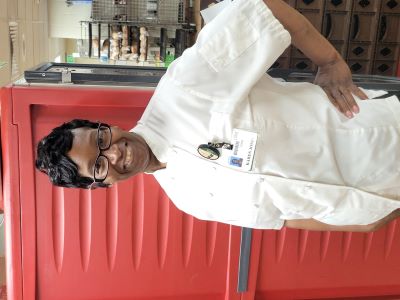
How long have you been at GBMC HealthCare?
27 years
What is one key way you support a zero harm/safety culture?
I provide safe and nutritious catering food services for GBMC.
What is the most rewarding part of your job?
I like cooking and preparing food. I mostly enjoy the expression on customer's face while eating food I prepared.
Favorite food?
Pasta
Bringing more than two decades of clinical and executive leadership experience, Dr. G is known for his commitment to transparency, accountability, and compassion. Learn more...
A few weeks ago, we held our latest systemwide Town Hall. Across the two virtual sessions, 509 people joi...
I hope everyone had a wonderful Fourth of July weekend and managed to stay cool."Hot" didn't really cover...
We rarely stop in healthcare. But a few weeks ago, we did, and it may have been one of the most important...
A few weeks ago, I had the privilege of helping mark a milestone that was both inspiring and humbling.Bob...
Around here, we talk a lot about treating every person the way we would want our own loved ones treated. ...
Last month, many of you took the time to complete our Employee Voice Pulse Survey, which was a brief chec...
Practical, compassionate guidance from GBMC clinicians for every stage of life.