Podcasts
Practical, compassionate guidance from GBMC clinicians for every stage of life.
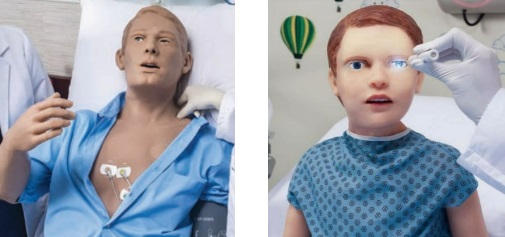
Late last year, our Simulation Innovation Learning Center welcomed two new state-of-the-art manikins – one adult and one pediatric “patient” - to enhance opportunities for staff training.
The new adult manikin, known as HAL by the manufacturer but as “Henry” at GBMC, is considered the world’s most advanced interdisciplinary patient simulator, designed for everything from emergency care to intensive care and med-surg training. Some of the features improving the trainee experiences include HAL's conversational speech functionality and lifelike motor movement.
As Deborah (Deb) Higgins, DNP, RN, CHSE, Simulation Manager & AHA Training Center Coordinator, explains: “He has more artificial intelligence-like responses, so the more you use him for scenarios, the more language he can learn, and he can be programed to have a conversation with his care team.” He can exhibit stroke symptoms that weren’t possible in previous models, such as a slight facial droop and limited one-sided arm movement. Now, rather than fully relying on standardized patient actors for stroke scenarios, the Simulation Center has this offering to add to its repertoire. Deb also goes on to explain the manikin’s movement capabilities beyond those of its predecessors. “If I place my hand on Henry, he can bring his hand up in an act to move my hand away. If I pinch his back to elicit a stimulus response, he can say ‘ow’ and reach for my hand.”
Some additional higher-fidelity features that are beneficial for physicians include advanced procedural capabilities; for example, placing an arterial line and performing chest tube procedures that feel more authentic than previous models of manikins.
The most notable enhancements of the Pediatric HAL (also known as Jordan at GBMC) is his ability to simulate lifelike emotions through dynamic facial expressions, movement, and speech, allowing providers of all levels to develop the specialized skills needed to effectively communicate with, diagnose, and treat young patients in nearly all clinical areas. “Our previous pediatric manikins had basic functionality – they were static manikins who could exhibit a pulse and whose chests could rise and fall,” says Deb. “This pediatric manikin’s facial expressions very accurately show happiness, sadness, fear, and upset. He cries tears and can make very realistic crying noises while pursing his lips and can even support himself in a sitting position, move his head and track things with his eyes.”
Deb concludes, “We are excited about these new additions to our Simulation Innovation Learning Center and continue to look forward to ways to continue upgrading with the most state-of-the-art capabilities.”

img.wellbeing { max-width:900px; } @media only screen and (max-width : 700px) { img.wellbeing { ma...
GBMC is committed to the wellness of each employee as a whole person – this includes physical, emotiona...
...
.contact-form { border: 1px solid #757575; text-align: center; padding: 15px; } A comp...
Ranked as one of the hospitals in Maryland with the highest stroke survival and recovery ratesAccording t...
Review GBMC’s Quality & Patient Safety Metrics — our transparency dashboard showing performance on CLABSI, hand hygiene, HCAHPS, hospice comfort, and more.”
Practical, compassionate guidance from GBMC clinicians for every stage of life.