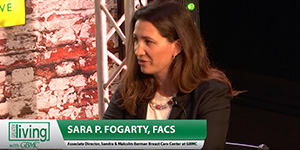
<iframe class="embed-responsive-item" src="https://www.youtube.com/embed/MsgI7Ti2bEw" allowfullscreen="allowfullscreen"></iframe> <p class="article-body"> One of the most powerful tools in early detection of breast cancer is mammography, but changing recommendations about when to start mammograms and how often to have them has many women confused. Sara Fogarty, DO, FACS, breast surgeon and director of the Sandra & Malcolm Berman Comprehensive Breast Care Center at GBMC, spoke with Mary Beth Marsden to provide answers to common questions about breast cancer screening and treatment and the role women can play in protecting their breast health. <br> <br> “Women have been receiving mixed signals about breast cancer screening,” said Dr. Fogarty. “While the U.S. Preventive Services Task Force changed its recommendation to mammograms every two years starting at age 50, the American Society of Breast Surgeons disagrees with this recommendation. Women should start mammograms at age 40, or younger in some cases if they have a family history of breast cancer, and should be screened every year using 3-D mammography, which allows us to see through dense breast tissue better.” <br> <br> Why are mammography screening guides so controversial? Dr. Fogarty explained that all medical procedures carry some risk. In the case of mammography, the concern is mostly focused on the possibility of unnecessary additional imaging and biopsies if the original images aren’t definitive, as well as the anxiety this uncertainty can cause women. <br> <br> The key to early detection, she said, is to know your breasts. You should do a self-exam every month the week after your period ends. If you find a change, talk with your primary care physician or gynecologist who can determine if you should see a breast specialist for evaluation. <br> <br> She also shared what the most common symptoms of breast cancer are, how caffeine and some medications can cause breast pain, which is not a symptom of cancer, and what role family history plays in building your own prevention and screening strategy. In addition to mammography, Dr. Fogarty explained that all women in their 20s and 30s should be screened to determine if they are at a higher risk for developing breast cancer. “At the Breast Center, we offer an online risk assessment tool. After completing the questionnaire, a member of our team will contact you to discuss your results and the recommended next steps.” </p>
<iframe class="embed-responsive-item" src="https://www.youtube.com/embed/bFNl3bBn_UY" allowfullscreen="allowfullscreen"></iframe> <p class="article-body"> October is breast cancer awareness month, but for women diagnosed with the disease and their physicians, the fight against breast cancer happens all year. Kruti Patel, MD, a radiation oncologist at GBMC, and Deirdre Gardner, a breast cancer survivor, talked with Mary Beth Marsden about their experience of breast cancer treatment. <br> <br> “Radiation is an important part of breast cancer treatment for many women, especially those who undergo a lumpectomy,” Dr. Patel explained. “Breast conserving therapy and radiation is very much about ‘saving the tatas,’ as the slogan says. We’ve come a long way from the days when mastectomy was the most common form of treatment for breast cancer. We’re now even able to treat lymph nodes with radiation rather than removing them surgically, which can cause fewer side effects.” <br> <br> Dr. Patel explained that radiation is used to eradicate microscopic cancer cells that the lumpectomy or other surgery may not have removed. With GBMC’s leading-edge technology, radiation oncologists are able to deliver a more controlled, targeted dose of radiation to the areas at risk and minimize the dose to the heart and lungs. In addition, for most patients, radiation lasts four weeks, compared to a few years ago when six and half weeks of radiation therapy was needed. <br> <br> “While some of my patients experience fatigue after treatment, many come in on their lunch hour from work and go back to work after treatment,” said Dr. Patel. “How you feel during treatment is very patient-dependent. There’s no right way to feel.” <br> <br> Deidre Gardner is very familiar with GBMC’s breast cancer team and the highs and lows of treatment. She found a lump in her breast in 2011, which was diagnosed as Stage 0 breast cancer. She chose to undergo a mastectomy and was glad she did when pathology after her surgery found cancer cells in other places in her breast. <br> <br> For five years, she was cancer free, but in 2016 she discovered a lump in her other breast, which turned out to be HER-2 positive breast cancer. She underwent chemotherapy to shrink the tumor, then a mastectomy and removal of lymph nodes, followed by radiation and additional rounds of chemotherapy. “Everyone at GBMC was compassionate and encouraging, which made a big difference,” Deirdre said. “They explained everything and kept me educated about all my options. With their support and my faith, I was able to look at treatment as a process you go through to get to the healing. I focused on staying positive, keeping people with a negative attitude or who looked at me with pity out of my circle. Treatment is a rollercoaster, but you need to allow yourself to feel sad or scared or angry, just don’t stay there. I relied heavily on my faith and scriptures on healing and believing there was more work in this life that God wanted me to do. For me, that work is being a living testimony that you can get through breast cancer.” </p>
<iframe class="embed-responsive-item" src="https://www.youtube.com/embed/JgtOB9Asfr0" allowfullscreen="allowfullscreen"></iframe> <p class="article-body"> Parents may struggle sometimes to decide whether they should take their children to a pediatrician or to the Emergency Department. During a recent interview on To Your Health, Laura B. Scott, MD, Director of the Pediatric Emergency/Inpatient Unit at GBMC, weighs in on which symptoms or situations warrant a visit to the ED, and explains some of the care techniques her team utilizes to help reassure sick or hurt children. Dr. Scott recommends that parents keep an open line of communication with their child’s pediatrician or family care physician to discuss illnesses and injuries first, but in general, the following issues are worth a trip to the ED: <br> <br> Trouble breathing (breathing faster or harder than normal) <br> Seizures <br> Burns, bad cuts, or falls from great height <br> Possible broken bones <br> Accidental medication or ingestion of harmful substances <br> Mental health concerns She notes that high fevers are especially difficult to decide. For especially young children, a fever is often an emergency. In older children, it’s not always about how high the fever is, but how long it has lasted and how the child is feeling otherwise (drinking, urinating, acting like themselves). </p>
<iframe class="embed-responsive-item" src="https://www.youtube.com/embed/6nfrH52WM_k" allowfullscreen="allowfullscreen"></iframe> <p class="article-body"> Having surgery can make anyone anxious, but it can be especially scary for children. To minimize the fear, GBMC’s Certified Child Life Specialists (CLS) work with children to develop coping techniques that help emotionally prepare them for the procedure. In this interview with Mary Beth Marsden, host of Greater Living Live, Jessica Correnti, a certified CLS at GBMC, discusses the role of the Child Life Program and gives tips to parents on how to help prepare their child for surgery. <br> <br> “Play is the universal language for children,” said Jessica, “we use play to show them what is going to happen before and during their procedure.” Play can mean something different for each patient. For teenagers, it can be as simple as a quick card game to ease anxiety and then talking through the steps of their surgery. For younger children, it can involve working with puppets or dolls to physically show them how their procedure will work. <br> <br> Regardless of the patient’s age, the CLS will use real medical tools during play to familiarize the patient with the equipment that will be used. Jessica used the puppet, named Hannah, to demonstrate some of the ways the CLS can help calm the patient. When Hannah comes into a room, she is wearing hospital pajamas and has a name bracelet on — something that normalizes what the patient is experiencing. “For younger children, something as simple as changing into hospital pajamas can cause a lot of anxiety. We use the puppets to alleviate the fear of the unknown.” Jessica also gave tips to parents to help them prepare their child for surgery. “The most important thing I say to parents is not to lie or sugarcoat,” she said, “the truth will come out and you don’t want to break the trust you have with them.” She also talked about how important it is for parents to take care of themselves. If the parents are overwhelmed and stressed out, they aren’t able to be as present with their child as they could be. Jessica said that something as little as sneaking out to get a snack can make a huge difference for parents caring for a sick child. </p>
<iframe class="embed-responsive-item" src="https://www.youtube.com/embed/rsSMDWKekvk" allowfullscreen="allowfullscreen"></iframe> <p class="article-body"> Few things are more stressful than learning that your child needs surgery. Eric Jelin, MD, and Clint Cappiello, MD, pediatric surgeons at GBMC and Johns Hopkins, talked with Mary Beth Marsden about the type of surgeries they perform, innovations in minimally invasive pediatric surgery, and how they provide care focused on the whole family. <br> <br> “We operate on more body parts than adult surgeons do,” explained Dr. Jelin. “They tend to be more specialized, but we handle a much wider range of types of surgeries, including surgeries on the chest and abdomen and surgeries for trauma and burns. We take care of the child from head to toe, with the exception of the heart, brain, and bones.” <br> <br> Training for pediatric surgeons is extensive. They first complete adult general surgery training then do a two-year pediatric surgery fellowship during which they perform about 1,500 to 2,000 surgeries. During their careers they will operate on patients ranging from one-pound newborns to adult-sized teens and even perform some surgeries on babies who are still in utero. <br> <br> “Our work is very collaborative,” said Dr. Cappiello. “We draw in doctors from multiple medical fields and pool our experience to provide the best possible care for our patients by combining our expertise. It’s an incredible responsibility that comes with incredible rewards.” <br> <br> New technology has made it possible to perform many types of pediatric surgery minimally invasively, including hernia repairs, gastrointestinal surgery, and surgery to repair the esophagus when it hasn’t developed properly before birth. “We continue to work to make complex operations less invasive, which can help patients recover more quickly, in many cases without a scar,” said Dr. Cappiello. <br> <br> Because Dr. Jelin, Dr. Cappiello, and their partners practice at both Johns Hopkins and GBMC, their patients have access to the full range of pediatric surgical care. If a surgery requires the resources of an academic medical center, they can transfer their patients to Johns Hopkins with just a phone call. “We understand that we are meeting our patients’ families on the worst day of their lives,” said Dr. Cappiello. “Through the care, communication, and support we provide for patients and their families, we try to make their life a little better at a difficult time.” </p>
<iframe class="embed-responsive-item" src="https://www.youtube.com/embed/5i6fc5exTSA" allowfullscreen="allowfullscreen"></iframe> <p class="article-body"> Every year in the United States, 172,000 men are diagnosed with prostate cancer. Because prostate cancer often shows no symptoms, it is critical for men to talk to their primary care provider about getting screened. National guidelines suggest that men should begin getting screened at the age of 50. In this interview, Radiation Oncologist and Vice Chair of Radiation Oncology at GBMC, Geoffrey Neuner, MD, discusses screening, diagnosis, and treatment of prostate cancer. <br> <br> While there aren’t many specific risk factors known for prostate cancer, some men are genetically predisposed to it. Men with a family history of prostate cancer should be proactive about talking to their doctor about their risk. African American men are also more likely to develop prostate cancer. One of the potential signs of prostate cancer is an elevated prostate specific antigen (PSA) level in the blood. PSA is a protein created produced by both cancerous and noncancerous cells in the prostate. Many noncancerous conditions can cause increased PSA levels, but it is an indicator that further testing may be needed. <br> <br> If prostate cancer is diagnosed, treatment plans are truly tailored to the individual patient. Because of the large variation in the ways that prostate cancer can progress, physicians gather as much information as possible about the patient’s physical condition and his medical history. This entails additional PSA blood tests, a digital rectum exam performed by the physician, and a biopsy of the cancer cells. One of the things differentiates prostate cancer from other cancers is that treatment isn’t always needed after a diagnosis. If the cancer is slow growing and at an early stage, patients may be placed on “active surveillance.” This includes regular PSA blood tests and yearly exams to ensure the cancer isn’t spreading. A new process that physicians use to predict the progression of the cancer is taking data obtained from other patients with similar genetic profiles. After a biopsy is completed, cancer cells can be genetically tested to determine specific characteristics for those cells. Although every patient is different, the progression of cancer in patients with similar cancer cells can be indicative of what will happen in the current patient. This information is used to create the most effective plan to treat the cancer. </p>
<iframe class="embed-responsive-item" src="https://www.youtube.com/embed/iYwBbamL6QI?rel=0&ecver=1" allowfullscreen="allowfullscreen"></iframe> <h2> Recipe </h2> 4 servings <br> Serving Size: 4-5 ounces <br> <br> <em>Ingredients</em> <br> <br> <strong>Pork Chops</strong> <ul> <li> 4 Pork Chops (6 oz portions) </li> <li> 1 Tbsp Extra Virgin Olive Oil </li> <li> Salt and pepper </li> </ul> <strong>Roasted Cinnamon Rosemary Butternut Squash: </strong> <ul> <li> 2 lb, butternut squash, large diced </li> <li> 1 Tbsp, extra virgin olive oil </li> <li> 1/4 cup rosemary, rough chopped </li> <li> 2 tsp, cinnamon </li> <li> salt and pepper, to taste </li> </ul> <strong>Granny Smith Apple Slaw: </strong> <ul> <li> 1 medium cabbage, cored, finely shredded </li> <li> 2 large carrots, peeled, julienne </li> <li> 1 bunch scallions, thinly sliced </li> <li> 4 Granny Smith apples, peeled, cored, julienned </li> <li> 1/4 cup apple cider vinegar </li> <li> salt and pepper, to taste </li> </ul> <em>Instructions</em> <br> <br> <strong>Pork Chops</strong> <br> 1. Salt and pepper the pork chops on both sides. <br> 2. Heat extra virgin olive oil in a sauté pan over medium heat. <br> 3. When the olive oil starts to perfume, add the 4 pork chops to the pan. <br> 4. Cook the pork chops for 3-4 minutes on each side. <br> 5. Set the pork chops to the side on a paper towel. <br> <br> <strong>Roasted Cinnamon Rosemary Butternut Squash </strong> <br> 1. Preheat oven to 350F. <br> 2. Toss butternut squash in olive oil. <br> 3. Add salt and pepper, rosemary, and cinnamon. <br> 4. Place on a half sheet tray and roast 20-25 minutes, or until tender. <br> <br> <strong>Granny Smith Slaw </strong> <br> 1. Combine vinegar, cabbage, carrots, scallions, and apples and toss all ingredients to combine. <br> 2. Season with salt and pepper to taste. <br> <br> <strong>Presentation</strong> <br> Place 4 oz of butternut squash in the center of the plate. Place the pork chop on top and top with drained apple slaw. <br> <br> <hr> Every month, GBMC holds a Facebook Live cooking demonstration featuring healthy recipes from The Sleeved Chef, Michael Salamon. Michael graduated from the Culinary Institute of America and is passionate about “teaching cooking techniques and recipes to pre- and post-operative bariatric patients.” He had a type of bariatric surgery known as a sleeve gastrectomy in September 2016 and enjoys sharing his knowledge of cooking with fellow weight loss patients. Co-hosting the demonstration with him is Jana Wolff, RD, LDN, Director of Nutrition for GBMC’s Comprehensive Obesity Management Program, where Michael was treated.
<iframe class="embed-responsive-item" src="https://www.youtube.com/embed/lExxE-1b750" allowfullscreen="allowfullscreen"></iframe> <p class="article-body"> <strong>Helping children and teens with sunken chest syndrome</strong> <br> <br> You may not have heard of pectus excavatum, which is also known as sunken chest syndrome, but it affects one in 500 children in the United States. Dr. Eric Jelin, Johns Hopkins Pediatric Surgeon at GBMC, talked with WMAR2 anchor Christian Schaffer about the symptoms of this condition and the treatments that can correct it. <br> <br> “Pectus excavatum occurs when the cartilage between the ribs and sternum does not form properly, resulting in a depression of the sternum,” he explained. “The chest can look like there’s a bowl in the center of it. One-third of cases are diagnosed during the first year of life, but the majority of cases are diagnosed after children go through a growth spurt at puberty. In some cases, the child has no symptoms, but for some the condition can cause pain and discomfort, can make breathing more difficult, especially during exercise, and can compress the left side of the heart making it pump less efficiently.” The condition, which affects more boys than girls, can be corrected with surgery, though not all children with pectus excavatum need to undergo the procedure. The goal of the surgery is to make the chest look and function as normally as possible. “We perform a minimally invasive surgery to insert a metal bar between the sternum and the mediastinum. That pops the sternum into the proper position. After two years, the bar is removed,” said Dr. Jelin. “We have a lot of experience performing this surgery and the prognosis is generally great. We have great resources and techniques that have been carefully honed over a number of years.” </p>
<iframe class="embed-responsive-item" src="https://www.youtube.com/embed/jXP6vL9zhQE" allowfullscreen="allowfullscreen"></iframe> <p class="article-body"> Clint Cappiello, MD, Johns Hopkins Pediatric Surgeon at GBMC, explains signs, symptoms, and treatment for appendicitis. </p>
<iframe class="embed-responsive-item" src="https://www.youtube.com/embed/Z-XiN7Qvmtc" allowfullscreen="allowfullscreen"></iframe> <p class="article-body"> For some older patients living with serious chronic health problems or life-threatening illnesses like advanced cancer a trip to the doctor may not be feasible. But that care is still an essential part of keeping that person as healthy and comfortable as possible. To ensure older patients in this situation have access to the care they need, GBMC and Gilchrist bring the care to the patient at home. Mary Beth Marsden talked with Beverly Ruiz, MS, CRNP, team lead for the Elder Medical Care Home Program at GBMC, and Leanna Hoover, MSN, NHA, director of Elder Medical Care for Gilchrist to learn more about how these programs work. <br> <br> “Patients with chronic conditions or serious illnesses can face frequent health crises,” explained Beverly. “These crises can lead to acycle of hospital, rehab, home that repeats over and over. Our goal is to break that cycle and intervene before the patient ends up back in the hospital. To do that, our team, which includes primary care physicians, nurse practitioners, and social workers, brings primary care services to people who are home restricted.” <br> <br> In addition to making sure people who can’t leave home are getting the care they need, this approach has other benefits. “The home setting is more conducive to healing,” said Leanna. “We become part of a broader care team that includes the patient’s family. And the family becomes more engaged and takes more ownership of disease management. Outcomes are better when patients are in their own environments.” <br> <br> The services that the GBMC and Gilchrist programs provide are different than skilled nursing home healthcare services. Beverly and her team provide a wide range of primary care services, including reviewing medications, addressing symptoms and concerns that the patient or family has, and connecting them to additional services like medical equipment and home healthcare support. They also talk with the patient and family to learn what their goals of care are, whether that’s remaining at home and managing symptoms or aggressive treatment. “Everyone needs a caregiver, whether they can get out to the doctor’s office or not,” added Beverly. “Rather than ending up in the ER frequently, we bring the care and support to our patients.” </p>
<iframe class="embed-responsive-item" src="https://www.youtube.com/embed/VxrNf6ysNxE" allowfullscreen="allowfullscreen"></iframe> <p class="article-body"> As we get older, most of us need a little extra help to do the things we used to do without thinking twice. For some people, that help comes from moving to an assisted living community or nursing home, but many people prefer to remain in their own homes. To help them do that as safely as possible, GBMC and Gilchrist partner with Avila Home Care. Avila’s President and CEO, Danny O’Brien, shared how his team can help, what services they offer, and the questions family members should consider when choosing a caregiver for a loved one. <br> <br> “We provide a wide range of services to help people thrive in the home they love,” said O’Brien. “From rides to doctor’s appointments, light housekeeping, meal prep, and medication reminders to help with bathing, dressing, and using the bathroom to assistance with administering medications. You name it, our staff members can do it. We work with both people who need some extra help after a hospitalization or illness for a brief period and people with serious illnesses and conditions like Alzheimer’s and dementia who need help and support on an ongoing basis.” <br> <br> To ensure a good fit, Avila first sends a nurse to the home to talk with the family and to do an assessment. Then the team puts together a care plan that’s customized to the family’s needs. There are no long-term contracts, and you can adjust the amount of support Avila provides as your needs evolve. Families can arrange just a few hours a day, a few days a week, or even 24/7 care. In addition to helping people in their homes, Avila provides caregivers for people in retirement and independent living communities, assisted living, and in the hospital. <br> <br> “When I’m hiring caregivers, I ask myself two questions,” O’Brien said. “Is caring for people a calling or just a job for this person? And second, would I choose this person to care for my own 91-year-old mother?” When choosing a caregiver for a loved one, O’Brien recommended asking each agency you talk with these questions: Are caregivers employees of the agency or subcontractors? Does the agency do a nurse assessment before sending caregivers to the home? What happens when the usual caregiver is sick or unable to come to work? And how well does the office support staff communicate with families? </p>
<iframe class="embed-responsive-item" src="https://www.youtube.com/embed/_1OTSj3CPMU?rel=0&ecver=1" allowfullscreen="allowfullscreen"></iframe> <h2> Recipe </h2> 4 servings <br> Serving Size: 4-6 ounces <br> <br> <em>Ingredients</em> <ul> <li> 1 1/2 lb skirt steak, thinly sliced against the grain </li> <li> 1/4 cup low-sodium soy sauce </li> <li> 2 limes, juiced </li> <li> 1 Tbsp olive oil </li> <li> 2 cloves garlic, minced </li> <li> 1 fresh gingerroot, minced </li> <li> 1 bunch scallions, sliced </li> <li> 1 red bell pepper, seeded and sliced </li> <li> 6 oz sliced baby bella mushrooms </li> <li> 4 oz fresh green beans, cut into halves </li> <li> 2 oz Sriracha sauce </li> <li> salt and pepper </li> </ul> <em>Instructions</em> <br> 1. Season the steak with salt and pepper. In a medium bowl, whisk together the soy sauce, sriracha and lime juice. Add the beef, toss, and set aside <br> 2. In a large skillet over medium heat, heat the olive oil. Add steak and sauce (from step 1) and simmer for 3-5 minutes until fully cooked. <br> 3. Remove the steak and set aside. Reduce the sauce in the pan until thickened, about 3-4 minutes. <br> 4. Add ginger, garlic and scallions and sauté for 1 minute. <br> 5. Add mushrooms and sauté until soft. <br> 6. Add green beans and bell peppers and sauté until soft about 2-3 minutes. <br> 7. Return the steak to the pan and toss. <br> 8. Serve immediately. Every month, GBMC holds a Facebook Live cooking demonstration featuring healthy recipes from The Sleeved Chef, Michael Salamon. Michael graduated from the Culinary Institute of America and is passionate about “teaching cooking techniques and recipes to pre- and post-operative bariatric patients.” He had a type of bariatric surgery known as a sleeve gastrectomy in September 2016 and enjoys sharing his knowledge of cooking with fellow weight loss patients. Co-hosting the demonstration with him is Jana Wolff, RD, LDN, Director of Nutrition for GBMC’s Comprehensive Obesity Management Program, where Michael was treated.
<iframe class="embed-responsive-item" src="https://www.youtube.com/embed/R-mRxTgUwyI" allowfullscreen="allowfullscreen"></iframe> <p class="article-body"> Paul Celano, MD, FACP, FASCO, Herman and Walter Samuelson Medical Director, Sandra and Malcolm Berman Cancer Institute at GBMC, explains conditions that may affect the pancreas, including pancreatic cancer. </p>
<iframe class="embed-responsive-item" src="https://www.youtube.com/embed/ujhNpcvDt7g" allowfullscreen="allowfullscreen"></iframe> <p class="article-body"> If you’re trying to lose weight by focusing on counting calories, Dr. Elizabeth Dovec, medical director of the GBMC Comprehensive Obesity Management Program has one word for you—stop. “Restricting calories can increase your glucose cravings, leading you to eat more rather than less. That’s why I tell patients not to count calories. All calories are not created equal, so focus on the nutritional quality of the calories.” <br> <br> Dr. Dovec shared her insights about weight loss and sugar addiction, noting that the increase in the number of people in the U.S. who are obese is closely tied to the increase in the amount of sugar we’re eating. She explained that on average, Americans consume 73 grams of sugar each day, with 25% of us consuming more than 150 grams a day and that amount increases each year. “By 2040, 95% of Americans will be obese if we don’t change our behavior,” she warned. “Sugar is eight times more addictive than crack cocaine, so the habit can be tough to break.” <br> <br> A big part of the issue is that people don’t realize how much sugar they’re consuming and where it’s hidden in their food. It’s not just in sweets and soda, there’s a significant amount of sugar in catsup, pasta, white and whole wheat bread, bagels, and more. <br> <br> The problem is the more sugar you consume, the more of it that’s stored as fat cells. In fact, eating too much sugar is the leading cause of fatty liver disease, which can lead to liver failure and the need for a liver transplant. Dr. Dovec shared how weight loss surgery and other strategies can help you kick your sugar addiction, lose weight, and lead a healthier weight. “One of the most important things is to know your ‘why’,” she said. “Why do you want to lose weight? We all have a why that motivates us, whether it’s better health, a long life with our family, or self-esteem. Find your why and you’ll be better able to stay on a path to weight loss.” </p>
<iframe class="embed-responsive-item" src="https://www.youtube.com/embed/ZSielugybKs" allowfullscreen="allowfullscreen"></iframe> <p class="article-body"> If your child needs surgery, Dr. Clint Cappiello, Johns Hopkins pediatric surgeon at GBMC, has a word of advice: “If you suspect there’s something wrong, don’t go on the Internet and get yourself in a panic. Come see us instead.” <br> <br> Dr. Cappiello performs general surgery on babies, children, and teens for a wide range of health issues, from hernias and appendicitis, which are some of the most common conditions he treats, to less common conditions such as pectus excavatum, a congenital condition that causes the ribs and breastbone to grow inward. Many patients come through the emergency department, but others are referred by their pediatricians. “In cases where it’s not an emergency, your pediatrician should be your first stop,” he explains. “They know which conditions require surgery and which can be managed medically. They’re our partners in caring for your child.” <br> <br> When a child does need surgery, he or she will be cared for by a team that specializes in treating children, including a certified child life specialist, pediatric anesthesiologist, and pediatric nurses and surgeons. <br> <br> “We try to take as much stress as possible out of the experience of surgery for our patients and their parents,” Dr. Cappiello says. “In non-emergency situations, a certified child life specialist meets with the child and family in the pre-op area to explain the process and answer questions, then the child walks to the OR with his or her parents and receives anesthesia through a mask. Once they’re asleep, we place the IV and do the other preparations needed for surgery. This approach helps minimize the patient’s anxiety and discomfort.” <br> <br> Dr. Cappiello also discussed the signs of appendicitis parents should know, why the problem is so common, and why children recover from surgery much faster than adults. “Unlike adults, children listen to their bodies and don’t push themselves too hard,” he explains. He adds, “I’m meeting parents on their worst day, so I make sure I always stop and listen to what they’re worried about. Then I can respond to their concerns and take them off the table, putting them a little more at ease on a tough day.” </p>